Conventions
Coordinate convention
Bluemira uses a conventional right-handed Cartesian coordinate convention for all geometry.
Occasionally, for certain modules and calculations, a quasi-toroidal coordinate system and a cylindrical coordinate system are used. Note that to facilitate conversion between the systems, the radial coordinate in the cylindrical coordinate system is denoted with \(x\) and not \(r\).
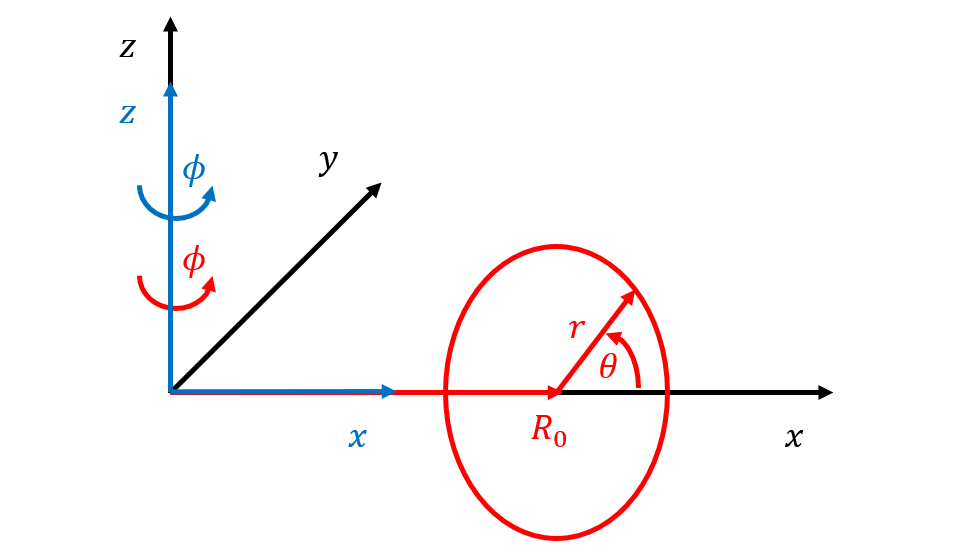
Fig. 2 The three different coordinate systems used in the bluemira framework: right-handed
Cartesian coordinate system (\(x, y, z\), black), quasi-toroidal coordinate
system (\(r, \theta, \phi\), red), and cylindrical coordinate system
(\(x, \phi, z\), blue).
Tokamaks are largely axisymmetric devices and usually have some form of cyclic symmetry.
In bluemira, by convention, tokamak sectors are numbered \(1 .. n\), with the first
sector ranging from \(0 .. 360/n_{TF}\) degrees, and subsequent sectors in increasing
number, going anti-clockwise as seen from above the machine:
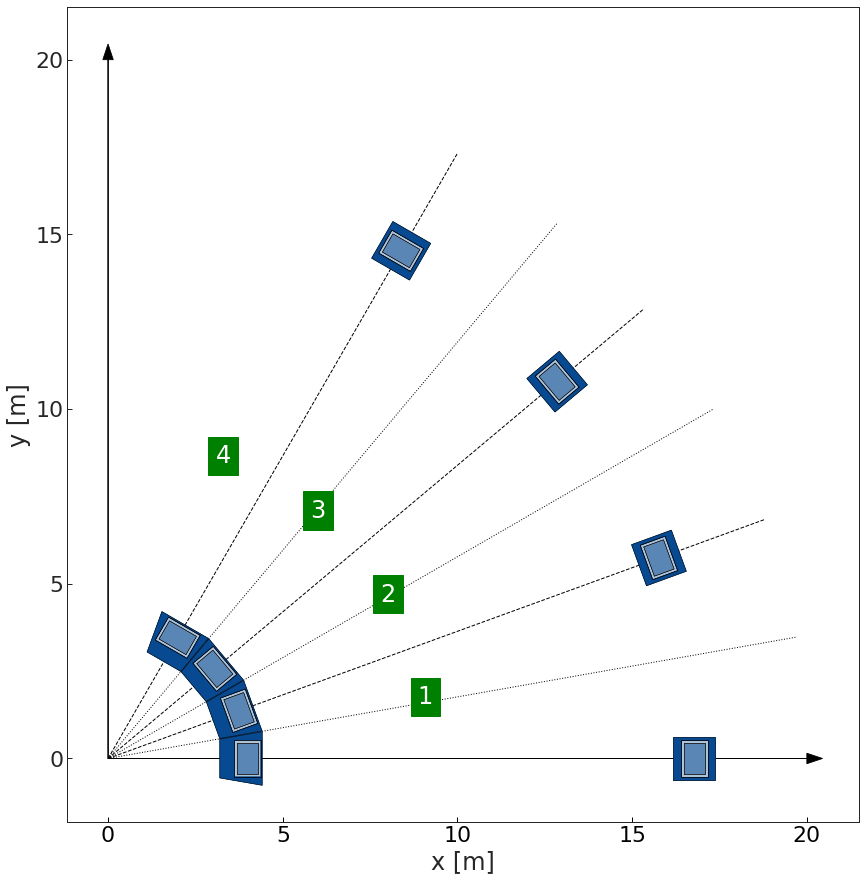
Fig. 3 Indicative sector angles and naming convention (green boxes) in bluemira
Unit conventions
Bluemira uses the International System of Units (SI) convention,
with only minor deviations. As a summary, all inputs to the code should be in the following units:
Quantity |
Unit name |
Symbol |
|---|---|---|
time |
second |
[s] |
distance |
metre |
[m] |
mass |
kilogram |
[kg] |
electric current |
ampere |
[A] |
temperature |
kelvin |
[K] |
amount of substance |
mol |
[mol] |
angles |
degrees |
[°] |
density |
kilograms per cubic metre |
[kg/m^3] |
particle density |
particles per cubic metre |
[1/m^3] |
flux density |
particles per square metre per second |
[1/m^2/s] |